
Understanding urban-rural disparities in infant mortality in Bangladesh: A decomposition analysis
Author:- Wasim Sami Khan, Abdur Rahman*
Category:- Journal; Year:- 2026
Discipline:- Statistics Discipline
School:- Science, Engineering & Technology School
Category:- Journal; Year:- 2026
Discipline:- Statistics Discipline
School:- Science, Engineering & Technology School
Abstract
Objectives
This study examines the determinants of infant mortality and the factors contributing to urban-rural disparities.
Study design
Quantitative cross-sectional study.
Methods
Secondary data from the Bangladesh Demographic and Health Survey (BDHS) 2022 were analyzed. Infant mortality, defined as death before the first birthday, was the primary outcome. A multilevel mixed-effects model was applied to identify determinants, while Erreygers' Corrected Concentration Index quantified urban-rural disparities.
Results
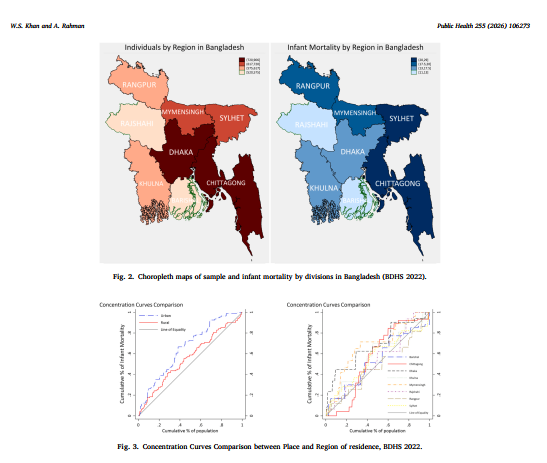
Among 5250 children included in the analytic sample, 2.5% died before their first birthday. The infant mortality rate was 1.33 times higher in urban areas (32 per 1000) than rural (24 per 1000). Individual-level factors associated with increased mortality risk included multiple births within three years (OR = 5.71; 95% CI:3.62–9.00), extreme birth sizes (OR = 3.24; 95% CI:1.79–5.85; OR = 3.04; 95% CI:1.90–4.88), multiparity (OR = 2.20; 95% CI:1.42–3.41), larger family sizes (OR = 3.04; 95% CI:1.86–4.96), and prior abortions (OR = 1.78; 95% CI:1.13–2.81). Community-level risk factors included urban residence (OR = 1.63; 95% CI:1.01–2.62) and larger community family sizes (OR = 2.02; 95% CI: 1.09–3.74). Urban-rural disparities were driven by place of delivery (ConI = 0.111), multiparity (ConI = −0.042), and women's work status (ConI = −0.027), while higher wealth levels (ConI = −0.036), family planning exposure (ConI = 0.056), media access (ConI = 0.132), and higher education (ConI = 0.011) helped reduce these inequalities.
Conclusion
Urban infant mortality remains disproportionately high, largely due to healthcare access barriers, shorter birth intervals, and high fertility rates. Addressing these disparities requires targeted interventions, including improving maternal education, expanding healthcare access, and reducing poverty to enhance infant survival outcomes in Bangladesh.