Impact of EXO1(K589E) Genetic Variant on Breast Cancer Risk: Evidence From Bangladesh
Author:- Md. Mahamudul Kabir, Md. Abdur Rahman, Sm Faysal Bellah, Md. Golam Hossain, and Md. Mustafizur Rahman
Category:- Journal; Year:- 2026
Discipline:- Pharmacy Discipline
School:- Science, Engineering & Technology School
Abstract
Background
Exonuclease 1 (EXO1) is a key nuclease in the DNA mismatch repair (MMR) pathway and is involved in correcting replication errors while maintaining genomic stability. The K589E (rs1047840) single nucleotide polymorphism (SNP) of EXO1 has been associated with cancer susceptibility in different populations.
Objectives
This study aimed to investigate the association between the EXO1 K589E polymorphism and breast cancer risk, as well as its relationship with selected clinicopathological characteristics in Bangladeshi women.
Design
Hospital-based case-control study.
Methods
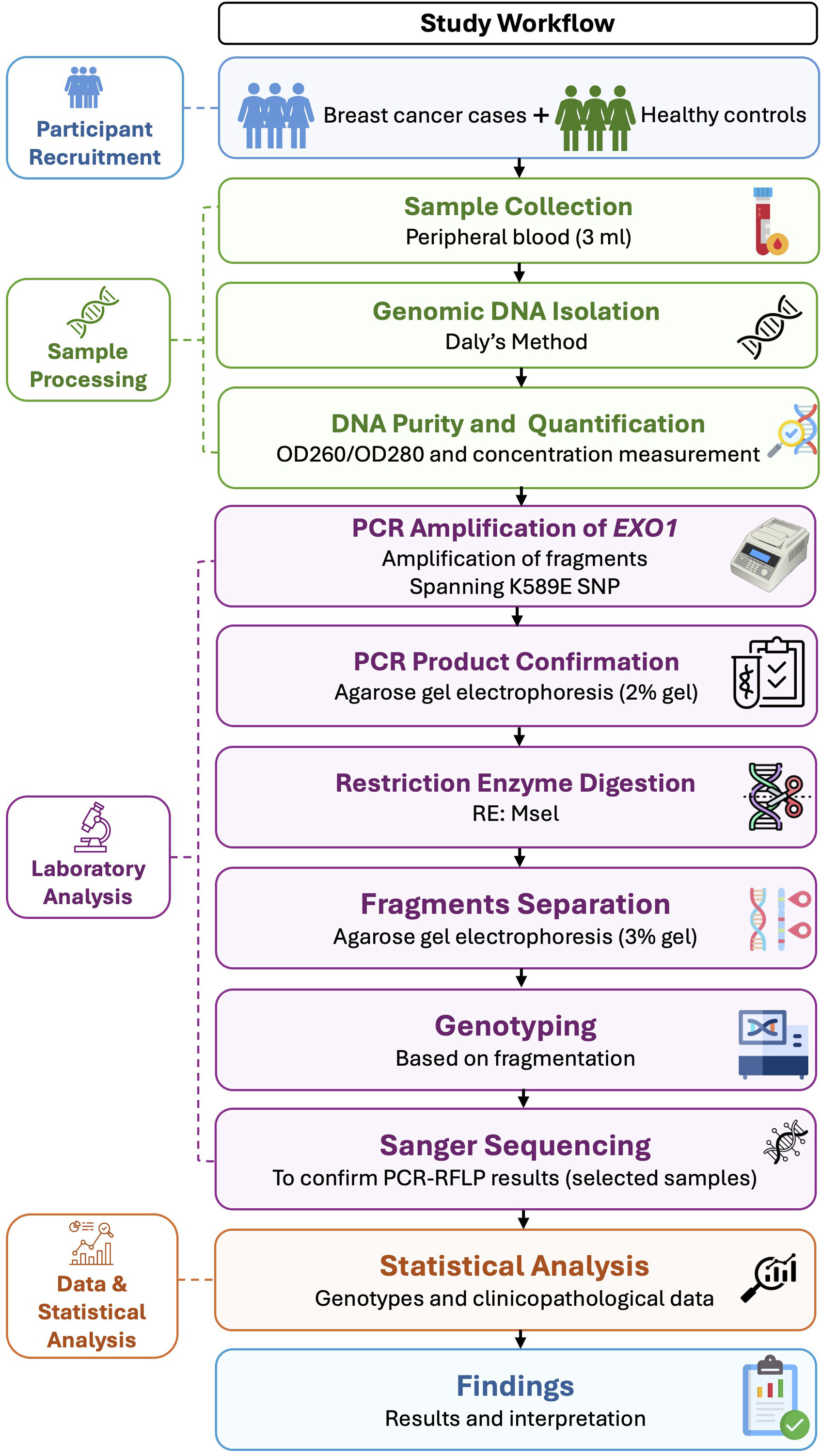
The present case–control study included 184 patients with histologically confirmed breast cancer and 200 age-matched cancer-free controls. Genotyping of the EXO1 K589E variant was carried out using polymerase chain reaction–restriction fragment length polymorphism (PCR-RFLP) analysis and subsequently confirmed by direct sequencing. The associations between the polymorphism and breast cancer risk were assessed using logistic regression, with odds ratios (ORs) and corresponding 95% confidence intervals (CIs) calculated.
Results
The frequencies of G/G, G/A, and A/A genotypes were 49.5, 41.8, and 8.7% among cases, compared with 69, 27.5, and 3.5% among controls, respectively. Both the heterozygous (G/A) and homozygous variant (A/A) genotypes were significantly associated with elevated breast cancer risk (OR= 2.12, 95% CI= 1.37-3.28, p= 0.0007; OR= 3.46, 95 % CI= 1.37-8.76, p= 0.0086, respectively). The combined variant genotypes (G/A + A/A) conferred a 2.27-fold higher risk (p= 0.0001), and the A allele was also strongly associated with breast cancer predisposition (OR= 2.01, 95% CI= 1.43-2.84, p = 0.0001). The association remained significant under codominant, dominant, recessive, overdominant, and log-additive genetic models. Significant correlations were observed between the variant genotype and menopausal status, body mass index (BMI), and tumor stage.
Conclusion
The results indicate that the EXO1 K589E polymorphism is significantly associated with an increased risk of breast cancer in Bangladeshi women and may also be related to key clinicopathological features of the disease.
Read More