
OPTIMIZING SPINACH (SPINACIA OLERACEA) YIELD, SOIL HEALTH AND NUTRIENT CONTENT ENHANCEMENT WITH POULTRY LITTER AND KITCHEN WASTE COMPOST
Category:- Journal; Year:- 2025
Discipline:- Soil, Water and Environment Discipline
School:- Science, Engineering & Technology School
Abstract
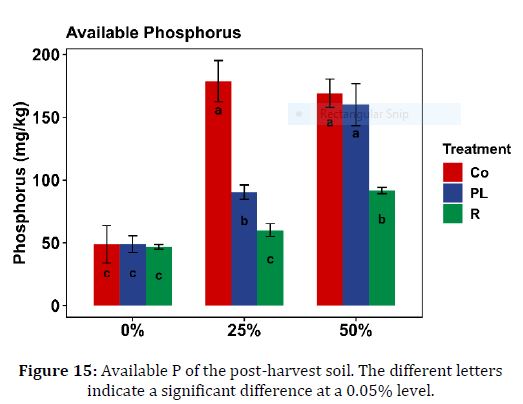
The increasing use of inorganic fertilizers is one of the significant causes of environmental pollution. The dependence upon fertilizers can be noticeably reduced with the elevated use of compost prepared from organic residues. Such practice improves the nutrient status of soil as well as saves our environment by managing waste. A study was carried out with nine treatments to show the effects of poultry litter and kitchen waste on soil properties and the growth of spinach plants. Clay loam soil was treated with different combinations of compost made with only poultry litter (PL) and co-compost (CC) prepared poultry litter mixed with kitchen waste by an aerobic process. The results showed that applying CC at 25% to the soil resulted in the highest spinach yield, leaf length, and number, fresh weight, and biological yield. Soil pH was found highest in CC50%, EC was high in PL50%, CEC was high in PL50%, and OC was high in PL25%. The study also showed that the available N of soil was higher by applying CC50%, and the available P, K, and S of soil was higher by applying CC25%. The nutrient content of spinach plants showed noticeable variation due to compost application. Using inorganic fertilizer as control (R)50% showed the highest N, K content of leaves and P content was high by applying CC25% and S content was high by applying PL50%. The findings indicated that co-composting of poultry litter and kitchen waste can be a useful method for boosting plant production and nutrient availability in soil.Poultry litter, kitchen waste, co-compost, nutrient content, spinach
Read More