
Microbial Immobilization and Phosphorus Transformation in Saline Soil: Effects of Organic Amendments
Category:- Journal; Year:- 2025
Discipline:- Soil, Water and Environment Discipline
School:- Science, Engineering & Technology School
Abstract
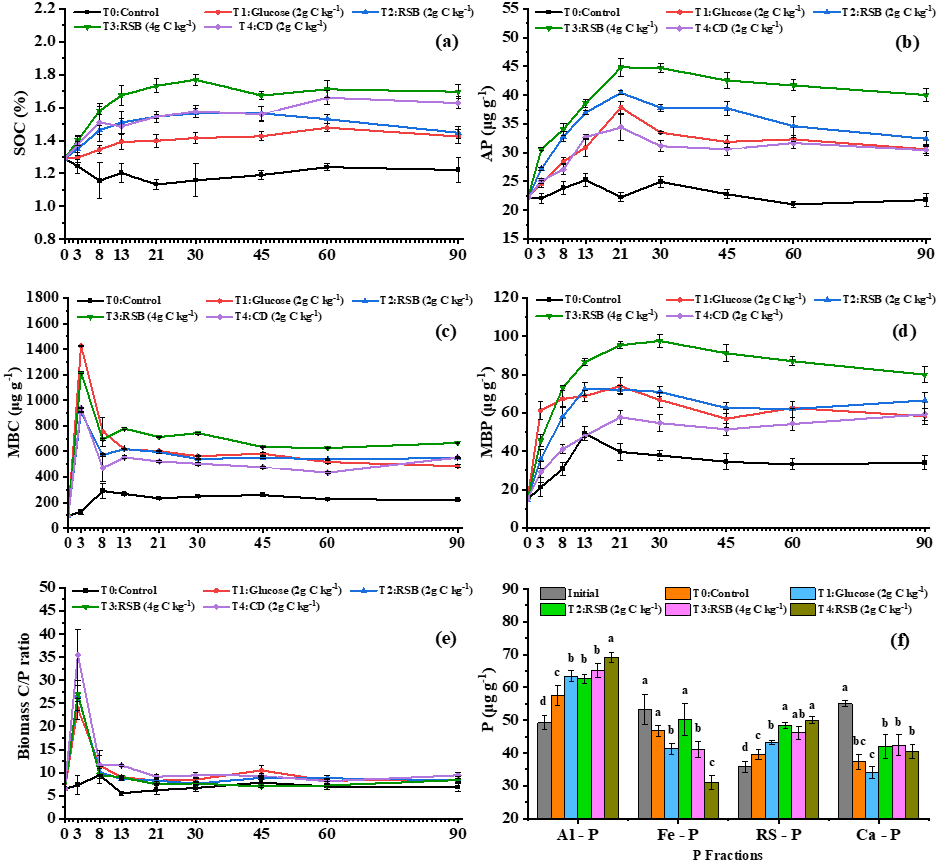
The significance of phosphorus (P) in plant physiology is impeded by its limited availability in saline soil, necessitating a comprehensive understanding of P transformation for effective P management. An incubation experiment was conducted in saline soil with different organic amendments (OA), glucose (T1: 2 g C kg− 1), rice straw biochar (RSB) (T2 and T3: 2 and 4 g C kg− 1, respectively), and cow dung (CD) (T4: 2 g C kg− 1), alongside a control (T0). The study found that RSB and CD led to improvements in soil properties such as exchangeable and water-soluble Na and K, cation exchange capacity (CEC), total N (TN%), and chloride (Cl−) content. Over 90 days, T3 showed consistently stable microbial biomass carbon (MBC), maintaining 2.4-3 times higher levels than the control (p < 0.05), and contributing the maximum microbial biomass P (MBP). The post-incubation C/P ratio in T2 and T3 ranged from 8.3:1 to 8.4:1, indicating a shorter time for RSB for microbial biomass contributing to MBP. After incubation, available P (AP) was 1.84 times higher in T3 (p < 0.05), whereas T1, T2, and T4 exhibited similar AP. PCA analysis revealed that among the variables, P associated parameters (i.e., AP, MBC, and MBP) were most significantly enhanced by RSB-T3 treatment. RSB application led to a favorable biomass C/P ratio, an accelerated MBP contribution, and enriched labile P pools by altering soil chemical properties, suggesting RSB’s efficacy in ameliorating saline soil P dynamics.
Read More