
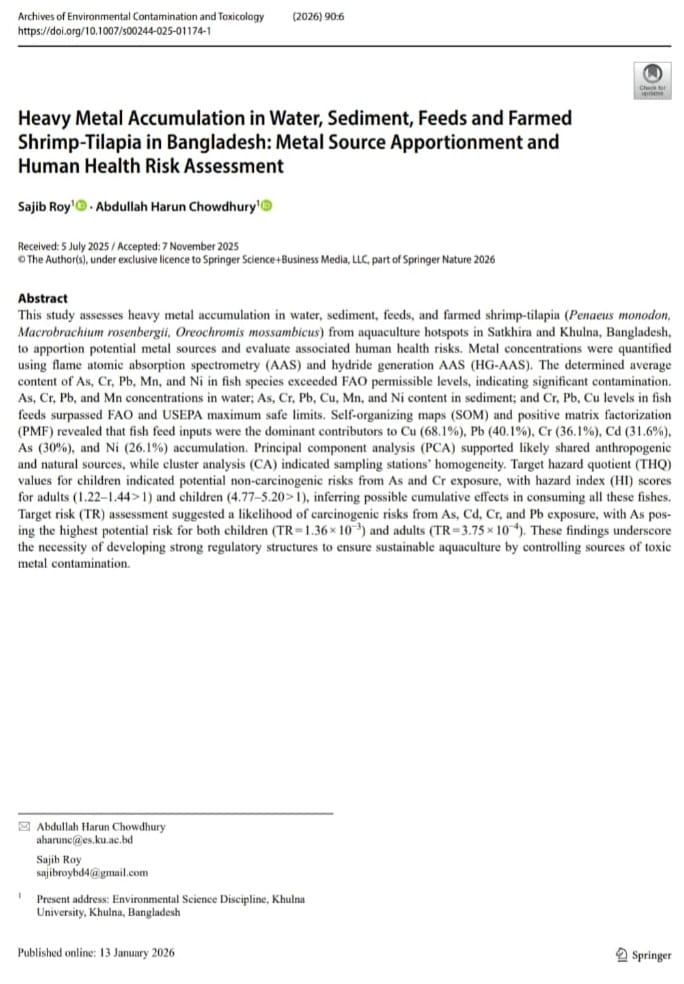
Heavy Metal Accumulation in Water, Sediment, Feeds and Farmed Shrimp-Tilapia in Bangladesh: Metal Source Apportionment and Human Health Risk Assessment
Category:- Journal; Year:- 2025
Discipline:- Environmental Science Discipline
School:- Life Science School
Abstract
This study assesses heavy metal accumulation in water, sediment, feeds, and farmed shrimp-tilapia (Penaeus monodon, Macrobrachium rosenbergii, Oreochromis mossambicus) from aquaculture hotspots in Satkhira and Khulna, Bangladesh, to apportion potential metal sources and evaluate associated human health risks. Metal concentrations were quantified using flame atomic absorption spectrometry (AAS) and hydride generation AAS (HG-AAS). The determined average content of As, Cr, Pb, Mn, and Ni in fish species exceeded FAO permissible levels, indicating significant contamination. As, Cr, Pb, and Mn concentrations in water; As, Cr, Pb, Cu, Mn, and Ni content in sediment; and Cr, Pb, Cu levels in fish feeds surpassed FAO and USEPA maximum safe limits. Self-organizing maps (SOM) and positive matrix factorization (PMF) revealed that fish feed inputs were the dominant contributors to Cu (68.1%), Pb (40.1%), Cr (36.1%), Cd (31.6%), As (30%), and Ni (26.1%) accumulation. Principal component analysis (PCA) supported likely shared anthropogenic and natural sources, while cluster analysis (CA) indicated sampling stations’ homogeneity. Target hazard quotient (THQ) values for children indicated potential non-carcinogenic risks from As and Cr exposure, with hazard index (HI) scores for adults (1.22–1.44>1) and children (4.77–5.20 >1), inferring possible cumulative effects in consuming all these fishes. Target risk (TR) assessment suggested a likelihood of carcinogenic risks from As, Cd, Cr, and Pb exposure, with As posing the highest potential risk for both children (TR=1.36× 10⁻³) and adults (TR=3.75×10⁻⁴). These findings underscore the necessity of developing strong regulatory structures to ensure sustainable aquaculture by controlling sources of toxic metal contamination.
Read More