
Comparative population parameters and stock assessment of three symmetric Scylla species in coastal waters of the Gulf of Thailand,
Category:- Journal; Year:- 2026
Discipline:- Fisheries & Marine Resource Technology Discipline
School:- Life Science School
Abstract
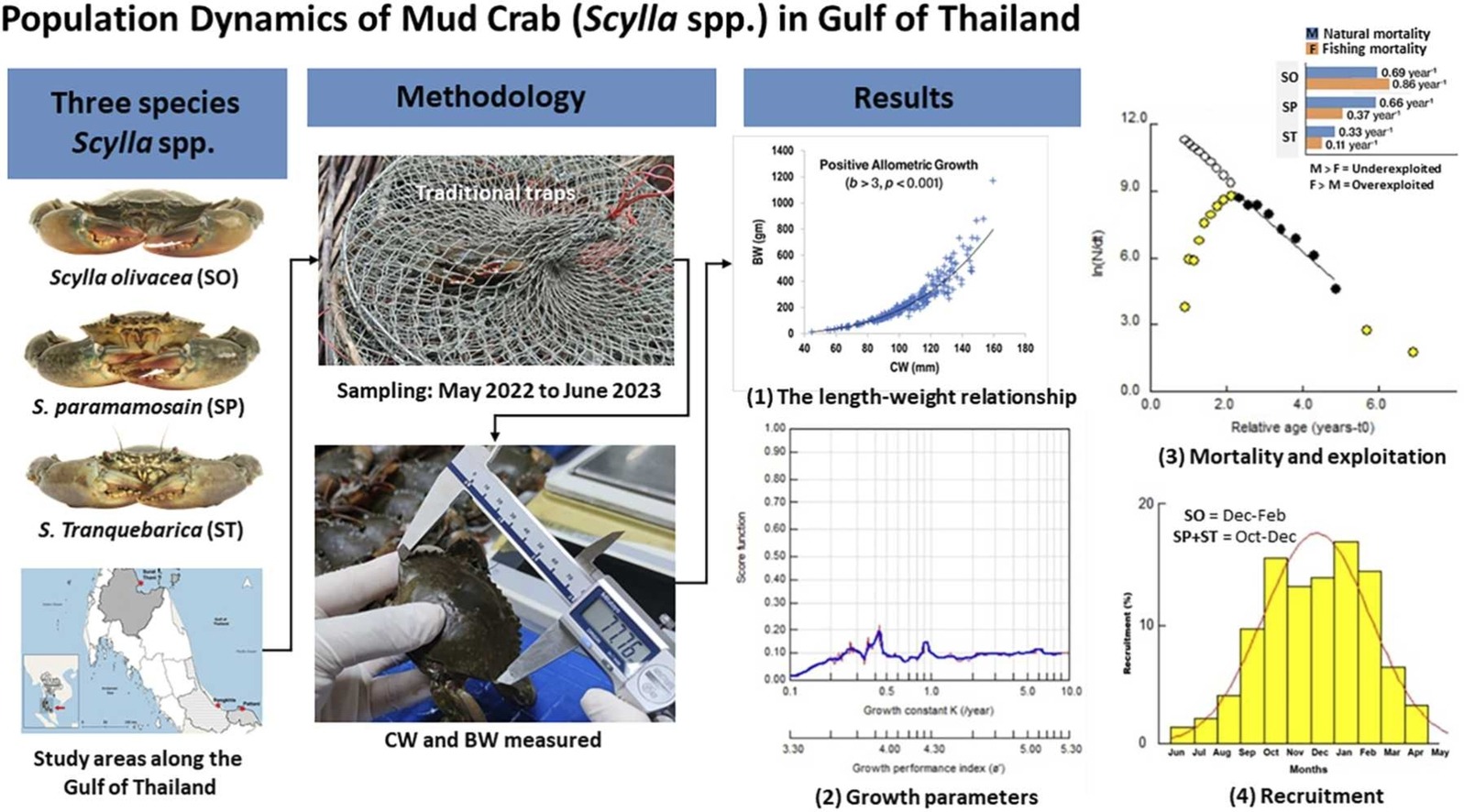
This study was conducted to determine the population structure, growth pattern, growth parameters, mortality, exploitation level, recruitment patterns, yield per-recruit (Y’/R), optimum catchable length (CWopt), and progression cohort of three sympatric mud crab species (Scylla olivacea, S. paramamosain, and S. tranquebarica) from the coastal areas of the Gulf of Thailand. Monthly sampling was conducted from May 2022 to June 2023 using traditional traps. Carapace width (CW) and body weight (BW) were digitally measured and analyzed with FiSAT-II software. CWopt was estimated using an empirical model based on maximum carapace length. The CW–BW relationship revealed significant deviations from isometry, showing positive allometric growth (b > 3, p < 0.001) for all three species. The estimated asymptotic parameters (CW∞, W∞, K) were 144.38 mm, 645.66 g, and 0.44 year−1 for S. olivacea; 160.13 mm, 1007.32 g, and 0.43 year−1 for S. paramamosain; and 160.13 mm, 914.99 g, and 0.15 year−1 for S. tranquebarica. The estimated natural mortality (M), fishing mortality (F), and exploitation (E) indicate overexploitation of S. olivacea (M = 0.69 year−1, F = 0.86 year−1, E = 0.56), whereas S. paramamosain (0.66, 0.37, 0.36) and S. tranquebarica (0.33, 0.11, 0.25) were underexploited. The peak recruitment occurred from December to February in S. olivacea, while S. paramamosain and S. tranquebarica exhibited similar peaks between October to December. These findings are crucial for developing science-based management strategies and conservation policies that ensure the sustainable use of these ecologically and economically valuable resources in the coastal ecosystems of the Gulf of Thailand.
Read More