
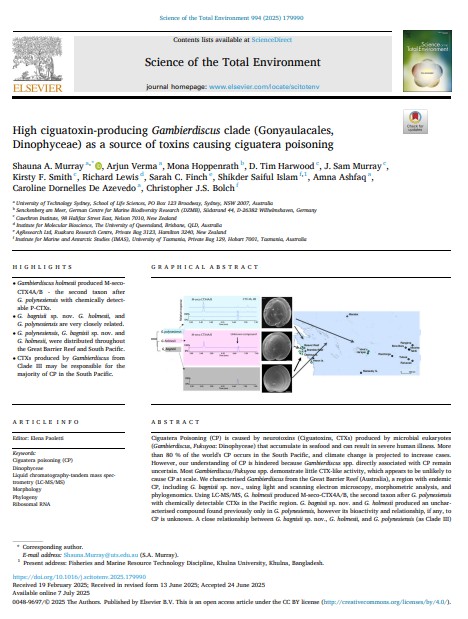
High ciguatoxin -producing Gambierdiscus clade (Gonyaulacales, Dinophyceae) as a source of toxins causing ciguatera
Category:- Journal; Year:- 2025
Discipline:- Fisheries & Marine Resource Technology Discipline
School:- Life Science School
Abstract
Ciguatera Poisoning (CP) is caused by neurotoxins (Ciguatoxins, CTXs) produced by microbial eukaryotes (Gambierdiscus, Fukuyoa: Dinophyceae) that accumulate in seafood and can result in severe human illness. More than 80 % of the world's CP occurs in the South Pacific, and climate change is projected to increase cases. However, our understanding of CP is hindered because Gambierdiscus spp. directly associated with CP remain uncertain. Most Gambierdiscus/Fukuyoa spp. demonstrate little CTX-like activity, which appears to be unlikely to cause CP at scale. We characterised Gambierdiscus from the Great Barrier Reef (Australia), a region with endemic CP, including G. bagnisii sp. nov., using light and scanning electron microscopy, morphometric analysis, and phylogenomics. Using LC-MS/MS, G. holmesii produced M-seco-CTX4A/B, the second taxon after G. polynesiensis with chemically detectable CTXs in the Pacific region. G. bagnisii sp. nov. and G. holmesii produced an uncharacterised compound found previously only in G. polynesiensis, however its bioactivity and relationship, if any, to CP is unknown. A close relationship between G. bagnisii sp. nov., G. holmesii, and G. polynesiensis (as Clade III) was found, and taxa were distributed from the far north to southern Great Barrier Reef and throughout the South Pacific. Our analyses indicate that CTXs produced by Gambierdiscus from Clade III, such as G. polynesiensis, are important in relation to CP and might be responsible for the majority of CP in the South Pacific.
Read More