
Antibiotic Sensitivity of Vibrio spp. and Shewanella algae Isolated from Brood and Egg of Mud Crab Hatchery
Category:- Journal; Year:- 2025
Discipline:- Fisheries & Marine Resource Technology Discipline
School:- Life Science School
Abstract
Mud crabs (Scylla spp.) with their high market demand and less
susceptibility to diseases are farmed in the coastal waters worldwide.
Although the availability of hatchery-produced crablets is a key
prerequisite of sustainable Mud crab aquaculture, the hatchery
production is at risk from diseases, frequently experiencing bacterial
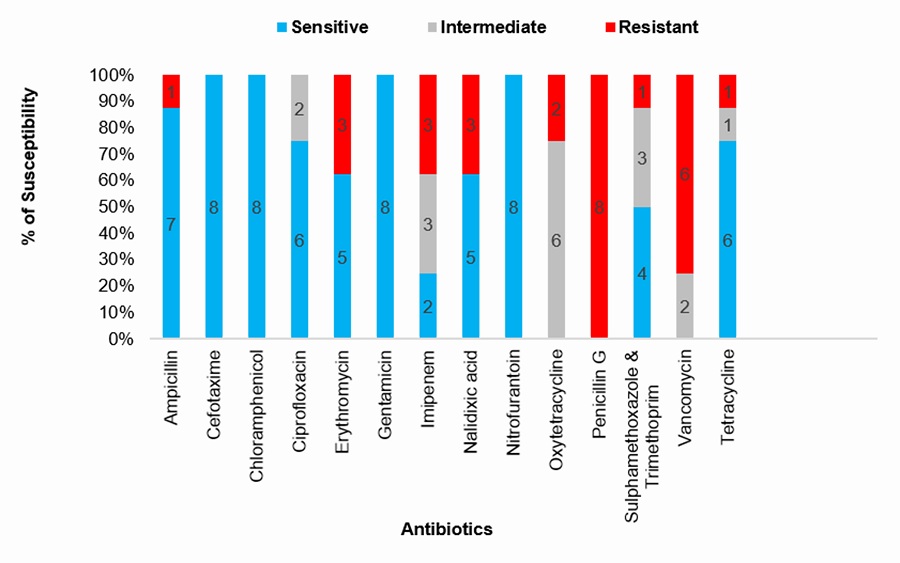
infection. The present study detected Vibrio parahaemolyticus and Shewanella algae DW01 strain in Mud crab brood, and Vibrio alginolyticus and Shewanella algae ATCC 51192 strain in egg samples. The antibiotic susceptibility test shows that Vibrio and Shewanella isolates were sensitive to cefotaxime, chloramphenicol, gentamicin, and nitrofurantoin; Vibrio parahaemolyticus strain was exclusively sensitive to erythromycin, ciprofloxacin, and nalidixic acid; V. alginolyticus to tetracycline; all S. algae
strains were found to be sensitive to ciprofloxacin and most (80%
isolates) were specifically sensitive to ampicillin, tetracycline,
nalidixic acid, sulfamethoxazole and trimethoprim. In contrast, V. alginolyticus strain was resistant to erythromycin, nalidixic acid, penicillin G, and vancomycin; V. parahaemolyticus strain was resistant to oxytetracycline, penicillin G, vancomycin, imipenem, and tetracycline; 60% S. algae strains were resistant to penicillin G and vancomycin. Accordingly, 75% isolates had multiple antibiotic resistance (MAR); V. parahaemolyticus, V. alginolyticus, and one S. alga ATCC 51192 strain had the highest MAR value (0.3571). The results implicate that the isolated Vibrio and Shewanella
strains had long-time exposure to several antibiotics, and
broad-spectrum antibiotics oxytetracycline, erythromycin, nalidixic
acid, and imipenem are no more effective against these bacterial
strains. This study suggests the stringent practice of biosecurity
measurements and appropriate utilization of approved antibiotics
(cefotaxime and gentamicin) in the context of infection type, intensity,
and environment.