
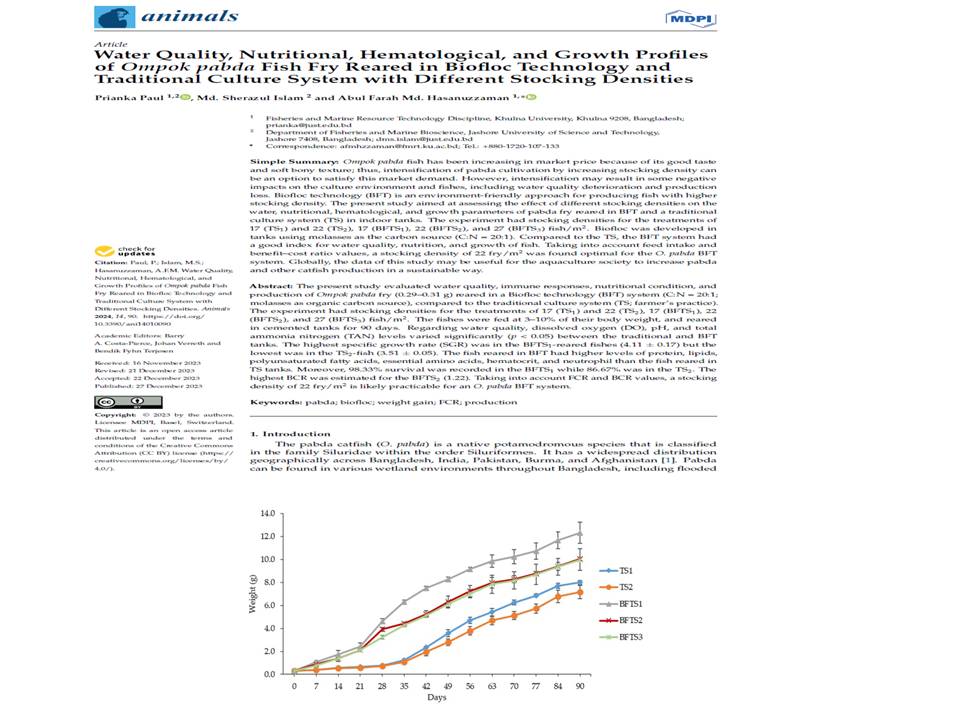
Water Quality, Nutritional, Hematological, and Growth Profiles of Ompok pabda Fish Fry Reared in Biofloc Technology and Traditional Culture System with Different Stocking Densities
Category:- Journal; Year:- 2023
Discipline:- Fisheries & Marine Resource Technology Discipline
School:- Life Science School
Abstract
The present study evaluated water quality, immune responses, nutritional condition, and
production of Ompok pabda fry (0.29–0.31 g) reared in a Biofloc technology (BFT) system (C:N = 20:1;
molasses as organic carbon source), compared to the traditional culture system (TS; farmer’s practice).
The experiment had stocking densities for the treatments of 17 (TS1) and 22 (TS2), 17 (BFTS1), 22
(BFTS2), and 27 (BFTS3) fish/m2. The fishes were fed at 3–10% of their body weight, and reared
in cemented tanks for 90 days. Regarding water quality, dissolved oxygen (DO), pH, and total
ammonia nitrogen (TAN) levels varied significantly (p < 0.05) between the traditional and BFT
tanks. The highest specific growth rate (SGR) was in the BFTS1-reared fishes (4.11 ± 0.17) but the
lowest was in the TS2-fish (3.51 ± 0.05). The fish reared in BFT had higher levels of protein, lipids,
polyunsaturated fatty acids, essential amino acids, hematocrit, and neutrophil than the fish reared in
TS tanks. Moreover, 98.33% survival was recorded in the BFTS1 while 86.67% was in the TS2. The
highest BCR was estimated for the BFTS2 (1.22). Taking into account FCR and BCR values, a stocking
density of 22 fry/m2 is likely practicable for an O. pabda BFT system.
Read More