
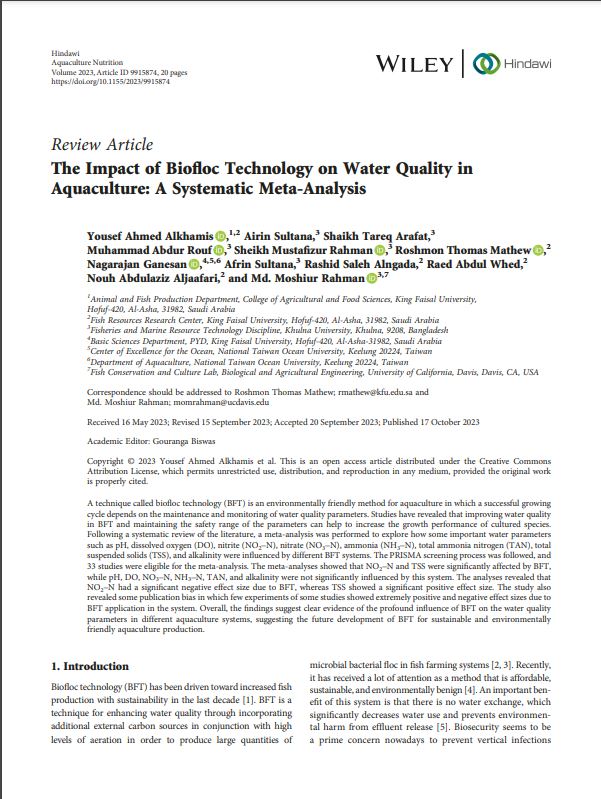
The Impact of Biofloc Technology on Water Quality in Aquaculture: A Systematic Meta-Analysis
Category:- Journal; Year:- 2023
Discipline:- Fisheries & Marine Resource Technology Discipline
School:- Life Science School
Abstract
A technique called biofloc technology (BFT) is an environmentally friendly method for aquaculture in which a successful growing
cycle depends on the maintenance and monitoring of water quality parameters. Studies have revealed that improving water quality
in BFT and maintaining the safety range of the parameters can help to increase the growth performance of cultured species.
Following a systematic review of the literature, a meta-analysis was performed to explore how some important water parameters
such as pH, dissolved oxygen (DO), nitrite (NO2–N), nitrate (NO3–N), ammonia (NH3–N), total ammonia nitrogen (TAN), total
suspended solids (TSS), and alkalinity were influenced by different BFT systems. The PRISMA screening process was followed, and
33 studies were eligible for the meta-analysis. The meta-analyses showed that NO2–N and TSS were significantly affected by BFT,
while pH, DO, NO3–N, NH3–N, TAN, and alkalinity were not significantly influenced by this system. The analyses revealed that
NO2–N had a significant negative effect size due to BFT, whereas TSS showed a significant positive effect size. The study also
revealed some publication bias in which few experiments of some studies showed extremely positive and negative effect sizes due to
BFT application in the system. Overall, the findings suggest clear evidence of the profound influence of BFT on the water quality
parameters in different aquaculture systems, suggesting the future development of BFT for sustainable and environmentally
friendly aquaculture production.