
Modulating cytokinin levels for efficient in vitro clonal propagation of potato (Solanum tuberosum L.) cultivars
Category:- Journal; Year:- 2026
Discipline:- Agrotechnology Discipline
School:- Life Science School
Abstract
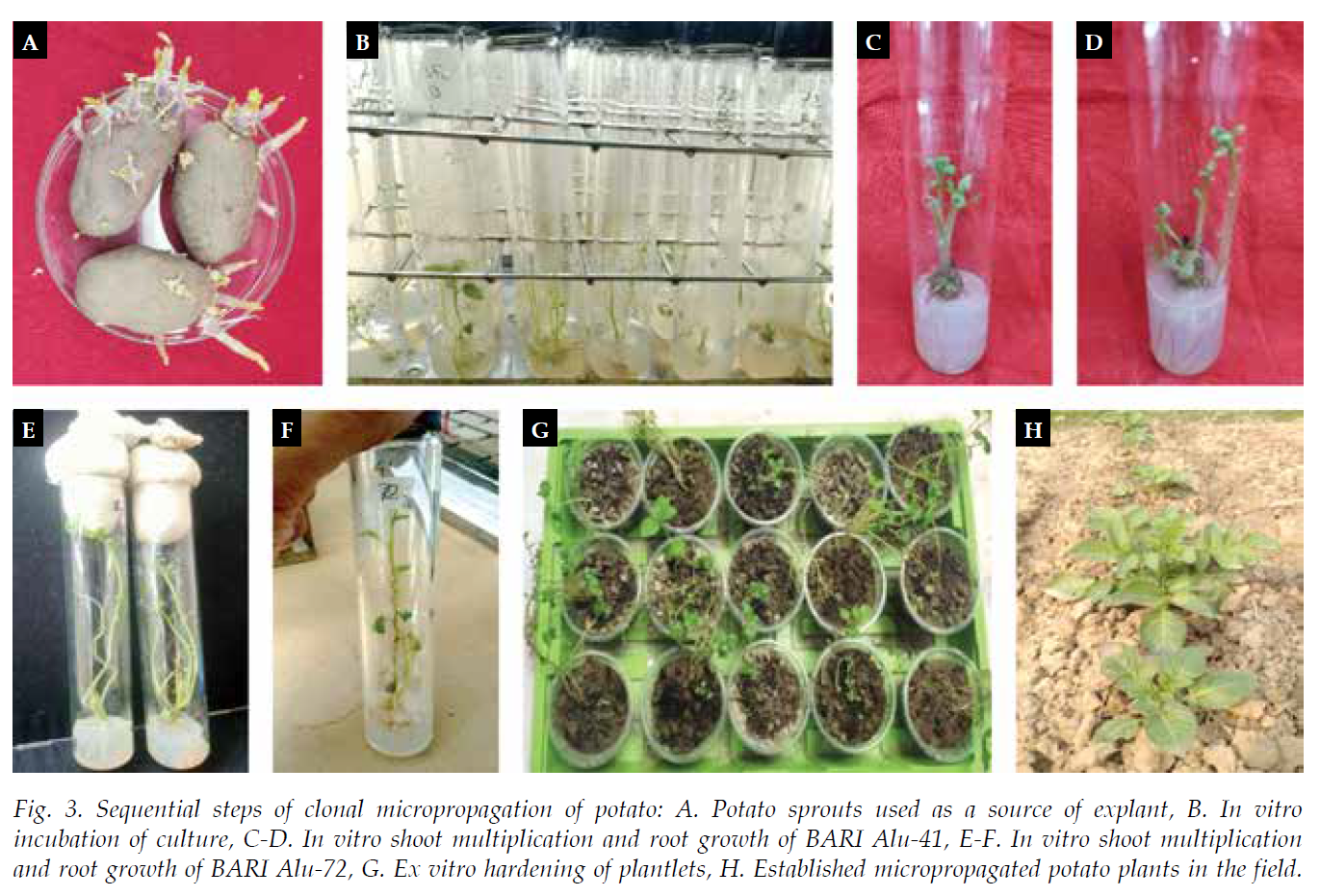
In vitro micropropagation has emerged as an efficient strategy for producing disease-free and genetically uniform potato (Solanum tuberosum L.) planting materials. The present study was conducted to evaluate the varietal response of two potato cultivars, BARI Alu-41 and BARI Alu-72, to in vitro regeneration under different concentrations of 6-benzylaminopurine (BAP). Shoot tip explants were cultured on Murashige and Skoog (MS) medium supplemented with varying BAP concentrations to assess their effects on shoot multiplication, node formation, leaf number, shoot length, and root traits. Significant differences were observed between the two varieties for most regeneration traits. BARI Alu-72 exhibited superior performance, producing a higher number of nodes (11.05), leaves (10.60), longer shoots (71.56 mm), and longer roots (26.07 mm) compared to BARI Alu-41. In contrast, shoot number and root number did not differ significantly between the varieties. BARI Alu-41 performed slightly better in ex vitro conditions than BARI Alu-72, reflecting genotypic differences in acclimatization. These findings indicate that BAP plays a critical role in stimulating shoot proliferation and plantlet growth. The differential varietal responses highlight that in vitro regeneration efficiency in potato is genotype-dependent, and thus, optimization of hormone combinations is essential for each cultivar. This study provides a reliable framework for variety-specific micropropagation, enabling rapid multiplication of disease-free seed potatoes to enhance productivity and ensure a sustainable seed supply in regions where viral and other systemic infections pose a major threat to crop production.
Read More