
Virulence Diversity of Pyricularia oryzae Cavara Associated with Rice Blast Disease in All Rice-Growing Areas of Bangladesh
Category:- Journal; Year:- 2026
Discipline:- Agrotechnology Discipline
School:- Life Science School
Abstract
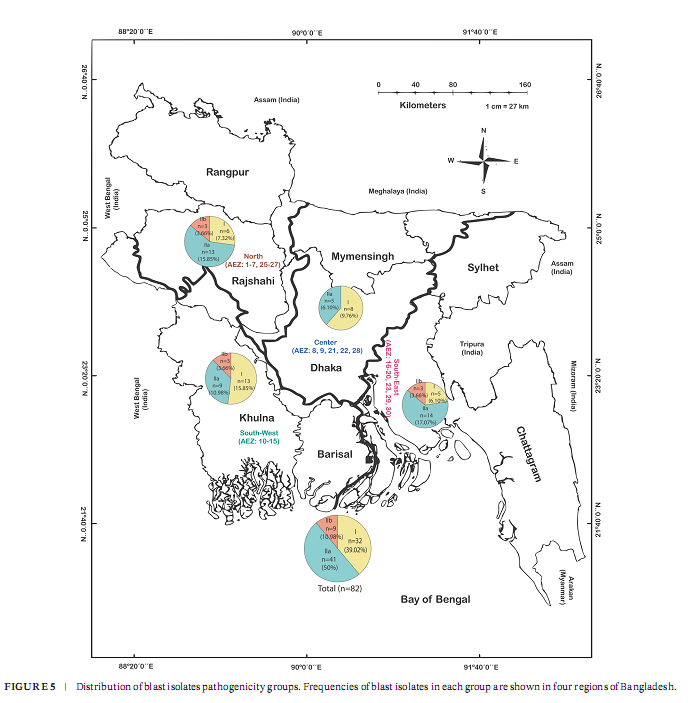
The evaluation of rice blast isolates for pathogenicity was performed to analyze the blast pathogen (Pyricularia oryzae Cavara) variability in Bangladesh. The pathogenicity of the isolates was categorized based on the reaction patterns of 25 differential varieties (DVs) each harboring a single blast resistance gene, and Lijiangxintuanheigu (LTH) was used as a susceptible check. The frequency of virulent isolates was high for DVs for Pia, Pib, Pit, Pik-s, Piz-t, Pi12(t), Pi19(t), and Pi20(t); intermediate for DVs for Pii, Pi3, Pi5(t), Pik-m, Pi1, Pik-h, Pik, Pik-p, Pi7(t), Piz, Piz-5, Pita-2(Pi), Pita(K1), and Pita(CP1); and low for the remaining three DVs for Pish, Pi9(t), and Pita-2(Re). The isolates were reclassified as reaction types of five groups viz., U, i, k, z, and ta where the groups had nine, seven, ten, nine, and seven different types of reactions, respectively. The high frequencies of blast isolates were found in U63, i7, i0, k177, k100, z04, z07, and ta403 reaction types, and were considered as dominant ones. The cluster analysis using the reaction patterns of the DVs classified the isolates into two major groups, and the frequencies of the blast isolates virulent to DVs differed completely among the 29 ecological zones. The blast isolates were categorized into 79 races by the international designation system based on the reaction types of the five groups. Finally, a total of 25 standard differential blast isolates (SDBLs) were selected that can be used as a new differential system for analysis of the pathogenicity of blast isolates and analysis of resistance genes in rice cultivars.
Read More