
Numerical studies of plasma emission in a mega joule plasma focus using Lee code
Category:- Journal; Year:- 2025
Discipline:- Physics Discipline
School:- Science, Engineering & Technology School
Abstract
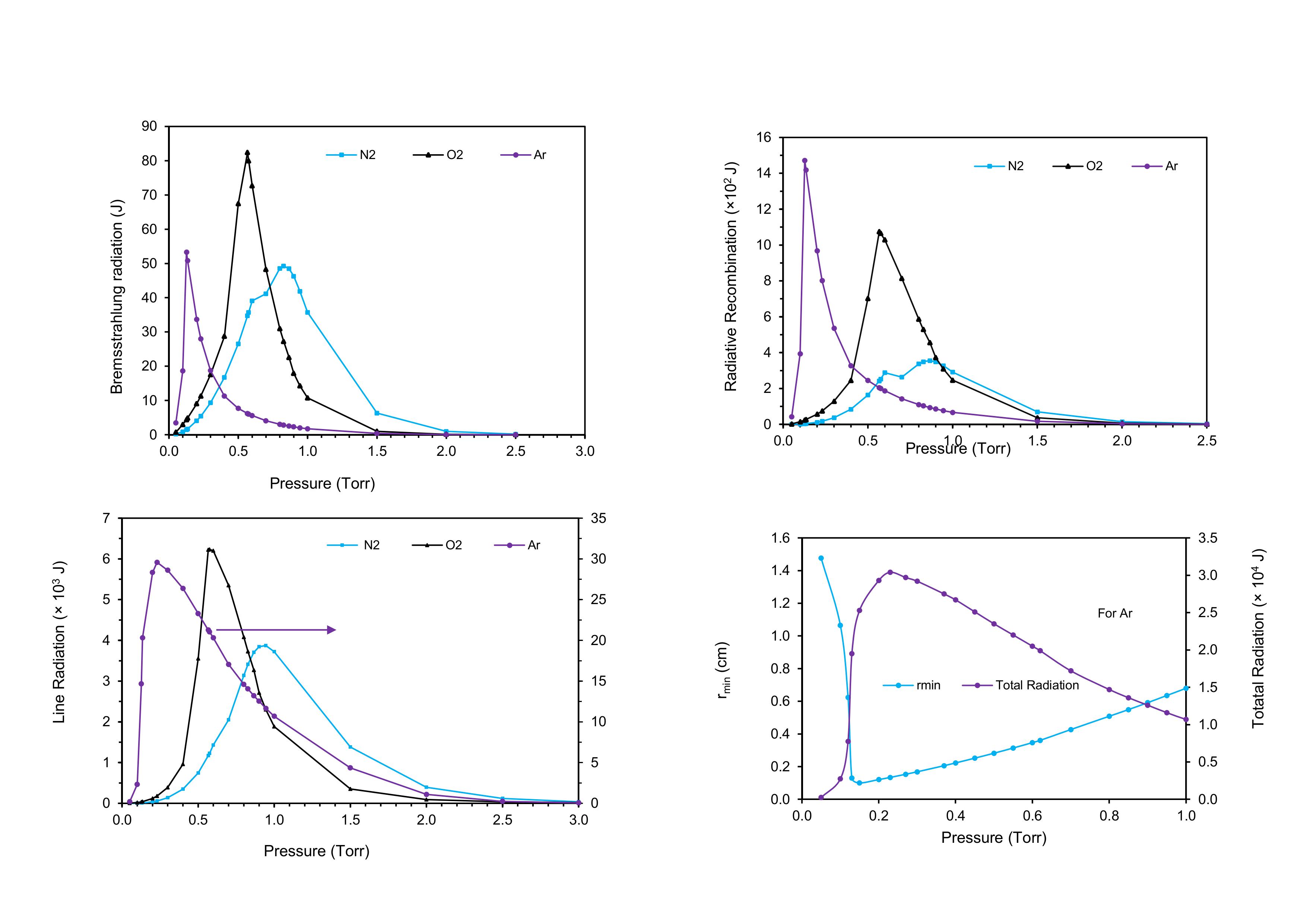
In this paper, plasma emissions (radiative recombination, bremsstrahlung, and line radiation) from a mega-joule plasma focus (PF1000) device is studied using the Lee code for nitrogen (N2), oxygen (O2) and argon (Ar) gases with pressure variation in the range of (0.05–2.5) Torr. Ion density, plasma velocity, pinch temperature, Joule heating, peak current, and minimum pinch radius are also obtained with pressure change for each of the gases. It is found that the line radiation is predominant compared to bremsstrahlung radiation and radiative recombination for each gas. At the optimum pressure, the maximum line radiations are found as: 3.9 kJ (91 % of total emissions) at 0.945 Torr N2, 6.2 kJ (85 % of total emissions) at 0.6 Torr O2 and 30 kJ (97 % of total emissions) at 0.23 Torr Ar, respectively. The minimum pinch radius (rmin) and consequent ion densitiy (Ni) of these gases are computed at their corresponding optimum pressures. It is found that the rmin (0.13 cm) of Ar is 10-fold smaller than N2 (1.25 cm) while it is 6-fold smaller in O2 (0.82 cm). This smallest minimum pinch radius of Ar produces the dominating ion density (71 × 10^23 m−3) compared to N2 (3 × 10^23 m−3) and O2 (5 × 10^23 m−3) gases resulting the highest line radiation is found for Ar. The sharp dropping of the pinch radius of Ar plasma followed by the greatest plasma emission (line) shows the strong evidence of radiatively-enhanced compressions.
Read More