
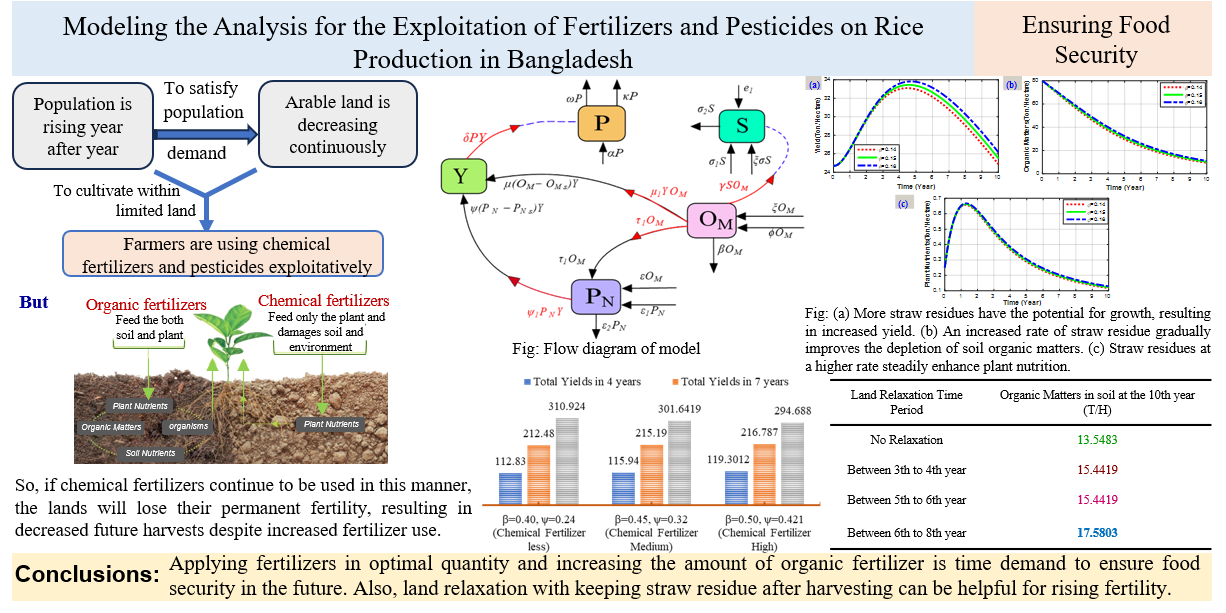
Modeling the Analysis for the Exploitation of Fertilizers and Pesticides on Rice Production in Bangladesh
Category:- Journal; Year:- 2024
Discipline:- Mathematics Discipline
School:- Science, Engineering & Technology School
Abstract
Rice is a dietary staple and vital economic crop for the majority of Bangladesh's population. To sustain yields amidst growing demand, the widespread application of chemical fertilizers and pesticides has led to concerns over soil health and long-term productivity. This study presents a novel mathematical model, comprising a system of non-linear ordinary differential equations (ODEs), to analyze the effects of diminishing soil fertility due to excessive fertilizer use. The model was investigated analytically and numerically, examining equilibrium points, stability, and the interactions between soil nutrients, plant nutrients, and rice yield. Numerical solutions were obtained using the Runge-Kutta method. Findings indicate that while the initial application of chemical fertilizers results in an increase in yield, prolonged usage ultimately depletes soil organic matters, causing a decline in long-term productivity. The improper use of organic fertilizers exacerbates soil salinity, further hindering rice cultivation. Additionally, rising global temperatures encourage pest proliferation, necessitating higher pesticide usage that adversely affects human health and the environment. The study underscores that optimal fertilizer application, combined with sustainable practices such as straw residue incorporation and land relaxation, improves soil fertility and ensures long-term productivity, addressing food security concerns. Optimal fertilizer application strategies are recommended to sustain rice yields and minimize adverse environmental impacts. The model's insights are crucial for policymakers and farmers in optimizing fertilizer and pesticide use to secure long-term rice productivity in Bangladesh while mitigating the risk of soil degradation.