
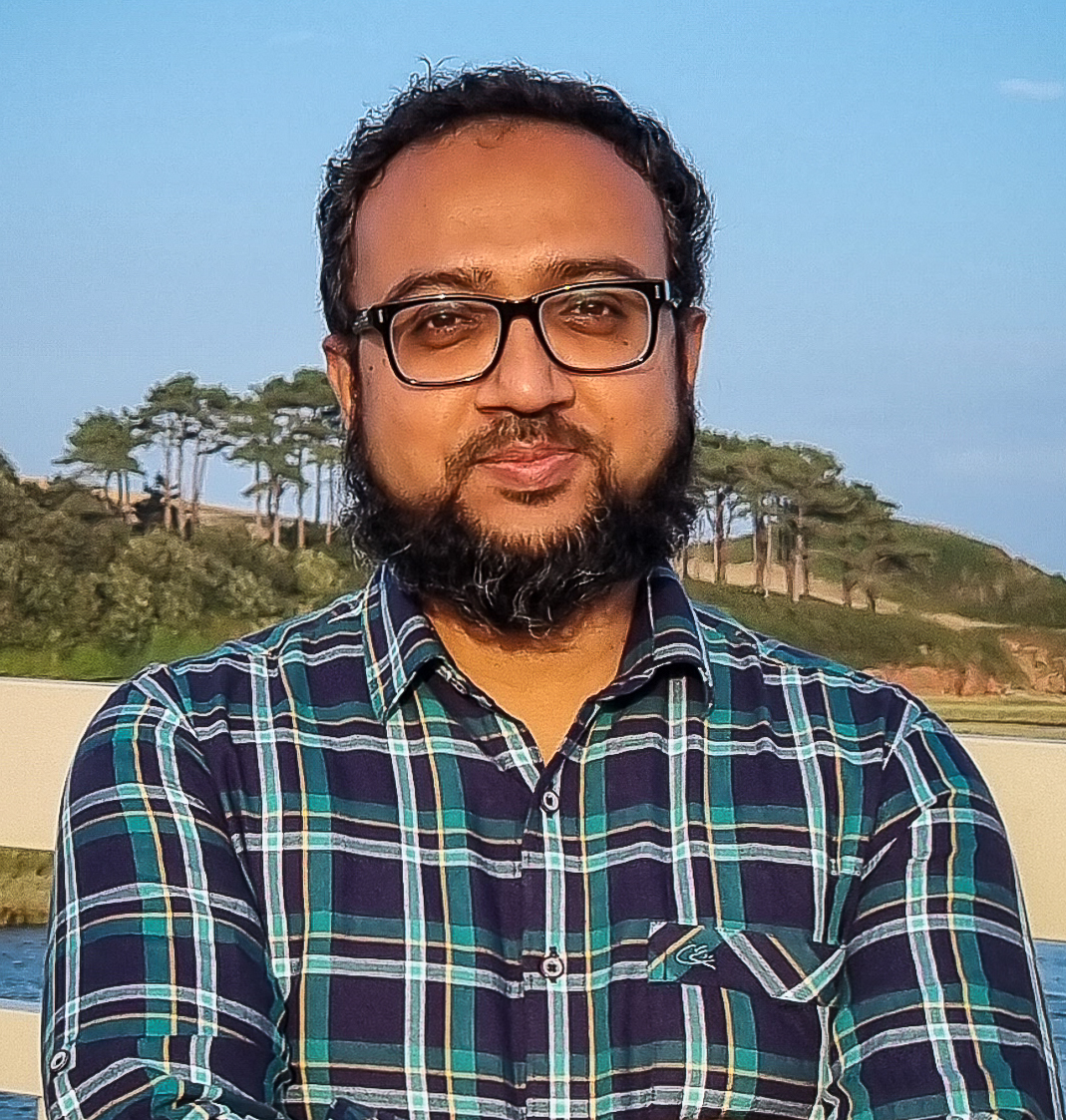
Dr A M Mahedi Hasan
Adjunct Faculty
Email:
a.m.m.hasan@ucl.ac.uk
Contact:
Address:
A M Mahedi Hasan is a Lecturer and co-lead of the MSc Cancer programme at the UCL Cancer Institute, where he leads modules spanning molecular biology, cancer therapeutics, multi-omics, and cancer research skills. With a PhD in Cellular and Molecular Biology from the University of Edinburgh and over a decade of research and teaching experience, he bridges rigorous computational science with accessible education. His work has been published in Nature Communications, Genome Medicine, and PNAS, and he has been co-investigator on Prostate Cancer UK-funded grants. A Fellow of Advance HE, he is also the Head of Computational Biology at BioTED, Bangladesh, where he has trained more than 200 professionals and graduate students in bioinformatics and cancer genomics.
Degree | Institution | Year | Notes |
PhD, Cellular & Molecular Biology | University of Edinburgh, UK | 2010–2015 | Thesis: Directionality of DNA Mismatch Repair in E. coli; supervised by Prof. David Leach; Darwin Trust Scholar |
MS, Genetic Engineering & Biotechnology | University of Dhaka, Bangladesh | 2007–2008 | First class, 1st position (79.67%); distinction |
BSc (Hons), Genetic Engineering & Biotechnology | University of Dhaka, Bangladesh | 2004–2007 | First class, 4th position (75.69%); distinction; Dean's Award 2010 |
Mahedi's research sits at the intersection of cancer genomics, computational biology, and translational oncology. His primary focus is the genomic evolution of advanced prostate cancer — particularly how tumours acquire treatment resistance through copy number alterations, clonal dynamics, and structural variation. He applies whole-genome sequencing, multi-omics integration, and cancer phylogenetics to post-mortem and longitudinal clinical cohorts to map the spatial and temporal trajectories of lethal disease.
Broader interests include:
- Cancer evolution & clonal dynamics: tumour heterogeneity, metastatic seeding patterns, and phylogenomic reconstruction
- Genomics of treatment resistance: PARP inhibitor resistance, androgen deprivation therapy response, and biomarker discovery
- Multi-omics integration: combining genomic, transcriptomic, proteomic, and spatial biology data to characterise cancer biology
- Bioinformatics methods & reproducible workflows: developing scalable NGS pipelines (Nextflow, Docker) and R packages for clinical genomics
- Cancer education & capacity building: training the next generation of cancer researchers in quantitative and computational methods
Current Research Project/Collaboration
| SL | Title | Research Role | Awarded Date | Completion Date | Funding Agency |
|---|---|---|---|---|---|
| No Research Project Available | |||||
Period | Role | Organisation |
Oct 2025 – present | Lecturer & MSc Cancer Programme Co-lead | UCL Cancer Institute, London |
May 2025 – present | Adjunct Faculty | University of Khulna, Bangladesh |
Dec 2019 – present | Head of Computational Biology | BioTED, Dhaka, Bangladesh |
Nov 2018 – Oct 2025 | Senior Research Associate (Computational Biology) | UCL Cancer Institute, London |
Mar 2015 – Nov 2018 | Postdoctoral Research Associate | University of Edinburgh, UK |
Jan 2010 – Sep 2010 | Bioinformatician | Jute Genome Project, Bangladesh |
No Data Available
Supervision
| SL | Title | Degree | Role | Start Date | End Date |
|---|---|---|---|---|---|
| No Supervision Available | |||||
No Data Available
coming soon...
Hasan A. M. M., Cremaschi P., Wetterskog D., …, Attard G. Copy number architectures define treatment-mediated selection of lethal prostate cancer clones (2023). Nature Communications, volume 14, Article number: 4823. https://doi.org/10.1038/s41467-023-40315-9
|
Grist E., Friedrich S., Brawley C., …, Hasan A.M.M., …, Attard G. (2022). Accumulation of copy number alterations and clinical progression across advanced prostate cancer. Genome Medicine 2022 14:1. 14, 1–15 (2022).
|
Hasan, A. M. M., Azeroglu, B. & Leach, D. R. F (2019). Genomic Analysis of DNA Double-Strand Break Repair in Escherichia coli. Methods in Enzymology, 612:523-554.
|
Hasan, A. M. M., & Leach, D. R. F. (2015). Chromosomal directionality of DNA mismatch repair in Escherichia coli. Proceedings of the National Academy of Sciences of the United States of America, 112(30), 9388–93.
|
Mahmud-Al-Rafat, A., Majumder, A, Rahman, K. M. T., Hasan, A. M. M., Islam, K. M. D., Taylor-Robinson, A. W. & Billah, M. M. (2019). Decoding the enigma of antiviral crisis: Does one target molecule regulate all? Cytokine. 115:13-23.
|
White, M. A., Azeroglu, B., Lopez-Vernaza, M., Hasan, A. M. M., & Leach, D. R. F. (2018). RecBCD coordinates repair of two ends at a DNA double-strand break, preventing aberrant chromosome amplification. Nucleic Acid Research, 46(13):6670-6682.
|
Islam, M. S., Saito, J. A., Emdad, E. M., Ahmed, B., … , Hasan, A. M. M., … Alam, M. (2017). Comparative genomics of two jute species and insight into fibre biogenesis. Nature Plants, 3, 16223.
|
Azeroglu, B., Mawer, J. S. P., Cockram, C. A., White, M. A., Hasan, A. M. M., Filatenkova, M., & Leach, D. R. F. (2016). RecG Directs DNA Synthesis during Double-Strand Break Repair. PLOS Genetics, 12(2), e1005799.
|
Sharmin, S., Azam, M. S., Islam, M. S., Sajib, A. A., Mahmood, N., Hasan, A. M. M., … Khan, H. (2012). Xyloglucan endotransglycosylase/hydrolase genes from a susceptible and resistant jute species show opposite expression pattern following Macrophomina phaseolina infection. Communicative & Integrative Biology, 5(6), 598–606. |